
Architecture · Business perspective
How Voluble AI is built — and why the architecture matters more than the voice
Every AI voice vendor will play you a demo of a natural-sounding call. Fewer can tell you, clearly, where that call's data goes afterward. That second question is the one worth spending time on — so here is how Voluble AI is actually put together, and why it holds up once you're past the pilot.
Reaching customers wherever they already are
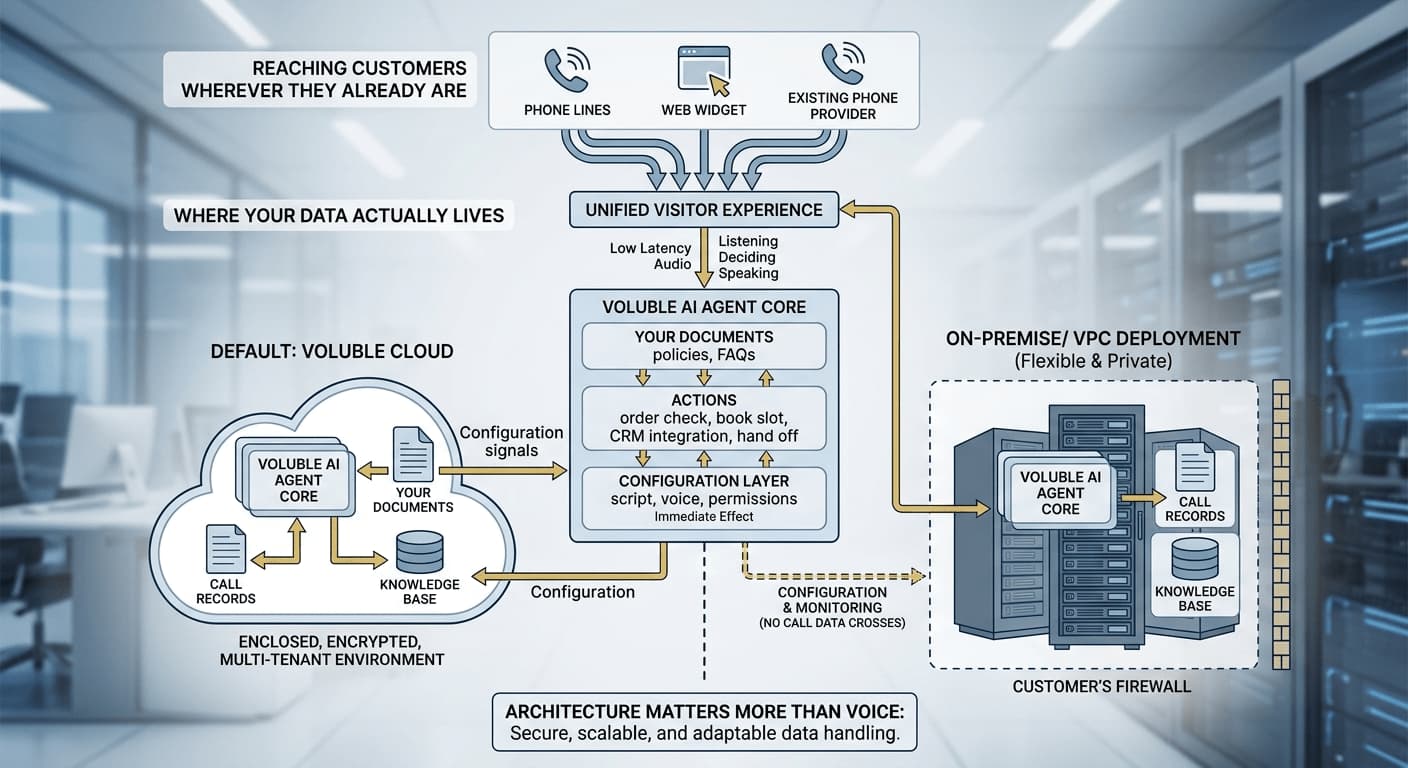
Nobody calls a business one consistent way anymore. A customer might dial the number on your invoice, tap "call us" on your website at midnight, or reach a line you ported over from your existing phone provider last year. Voluble AI treats all of it as one channel. A phone line, a web widget embedded on your site, or a number moved in from another provider — each one lands the caller with the same agent, behaving the same way, answering from the same knowledge. There's no "the phone version" that's slightly worse than "the web version." There's one agent, reachable everywhere.
That's also why adding a new channel later — a second phone provider in a new country, say — is a configuration change on our side, not a project on yours.
What actually happens on a call
Once a call connects, it moves through two things working together: a routing layer that keeps the audio flowing in real time, low enough latency that a conversation doesn't feel like talking to a machine on a delay, and the agent itself — the part that listens, decides what to say, and says it. The agent doesn't answer from a generic training set. It answers from your documents: policies, product sheets, FAQs, whatever you've handed it. Ask it something outside that scope and it says so, rather than inventing an answer, which is the failure mode that actually matters in a regulated business.
Behind the scenes, that agent can also do things — check an order, book a slot, pull a record from your CRM, hand off to a person — because those actions are configured, not custom-built for you. Which is also why changing an agent's script, voice, or permissions takes effect on the next call, not the next release cycle. There's no redeploy waiting between "we decided to change this" and it actually changing.
Where your data actually lives
This is the part that gets skipped in most pitches, so here it is directly. By default, Voluble AI runs your agents, stores your call records, and hosts your knowledge base in our cloud — encrypted, and walled off per customer so no data ever crosses between tenants.
But "by default" isn't "only option." For businesses handling data that legally cannot leave their own walls — a bank, a real estate brokerage holding client financial documents, an insurer, a healthcare provider — the architecture splits cleanly along a line that already exists inside it. The pieces that touch actual call content — the routing engine, the agent, the knowledge base, the recordings and transcripts — deploy inside your infrastructure: your cloud account, your data center, behind your firewall. Voluble AI's console still connects in, because someone still needs to configure the agent and see that it's healthy — but what crosses that line is configuration and monitoring signal, never the calls themselves.
How a call is handled
Security that holds up under audit, not just a demo
Every customer's agents, calls, and credentials are isolated from every other customer's — enforced at the data layer, not just hidden behind a login screen. Phone provider credentials and other secrets are encrypted at rest by default, with support for enterprise key management like AWS Secrets Manager or HashiCorp Vault where a compliance team requires it. And because an agent's knowledge base is fed by whatever documents you upload, that content is sandboxed away from the agent's core instructions and screened for attempts to manipulate it — a real risk once you put an AI in front of real callers, not a theoretical one.
Every call, on the record
Every call produces a recording, a full transcript, and — when you want it — a structured summary pulling out exactly what your team cares about: sentiment, action items, whether a required disclosure was actually said. Recordings are served through time-limited secure links rather than open storage, so a manager reviewing calls doesn't have to sit in on them live, and an auditor asking "what did the agent actually say" gets an answer that doesn't depend on trusting the AI.
Want to see how a private deployment would look for your business specifically? Talk to us about your compliance requirements.